Every new mode gets accused eventually
CW became the archetypal amateur skill: a human ear pulling dots and dashes from noise and a human hand sending them back. Then AM made the airwaves sound human, and a Morse operator could jokingly wonder why anyone needed to learn code if they could simply talk.
SSB was the next efficiency scandal. By suppressing the carrier and one sideband, it made voice communication more spectrum- and power-efficient than conventional AM. Today it is the familiar voice workhorse, but it once offered an easy target for the old joke: “Your receiver is doing half the work.”
RTTY, packet, PSK31, JT modes and other digital modes shifted some copying work to carefully designed signals and software. The amateur part remains in the choices: station design, antennas, power, band selection, timing, propagation, and operating judgment.
FT8 in plain English
FT8 is a weak-signal digital mode created by Joe Taylor, K1JT, and collaborators. It uses eight-frequency-shift keying and short, structured messages. A transmission lasts about 13 seconds and begins on a synchronized 15-second cycle. The software sends compact information such as callsigns, signal reports, grid squares, and confirmations using closely spaced tones in a narrow slice of spectrum.
At the other end, software knows the timing and message format, listens for those tones, and uses error-correcting coding to decide what was most likely sent. A stable computer clock matters because everyone needs to start the 15-second “sentence” together.
FT8 and SSB are different tools
SSB carries a live human voice: personality, conversation, operating nets, and the occasional microphone mishap. FT8 excels at short, structured exchanges on weak or crowded paths where voice may not be intelligible. One is not more legitimate than the other. They answer different operating questions.
A small station and a big lesson
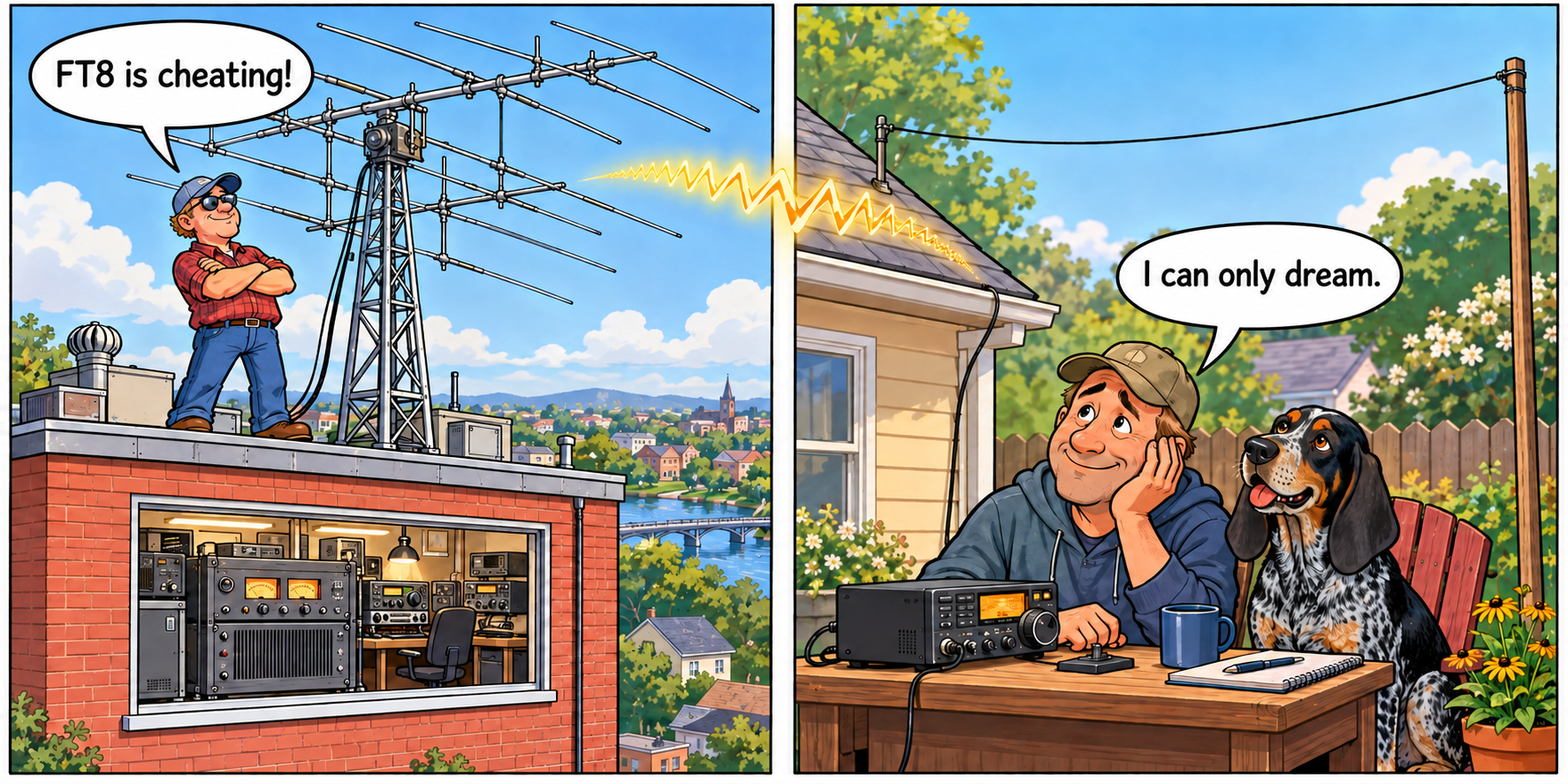
I ran across another ham on a messaging board who said FT8 is cheating. I asked him what his setup was. He had a multi-beam antenna using over a kilowatt of power and was located high up on top of a building—while comparing it to a small 100 W radio with just a wire antenna.
The point is not that a big station is wrong; building one can be a marvelous accomplishment. The point is that every station has advantages. Before declaring somebody else’s tool “too easy,” it is worth glancing at our own tower, amplifier, elevation, antenna gain, filters, software, experience, and good fortune with propagation. Then we can all get back to the important business: making contacts.